
What is Kensaku AI?
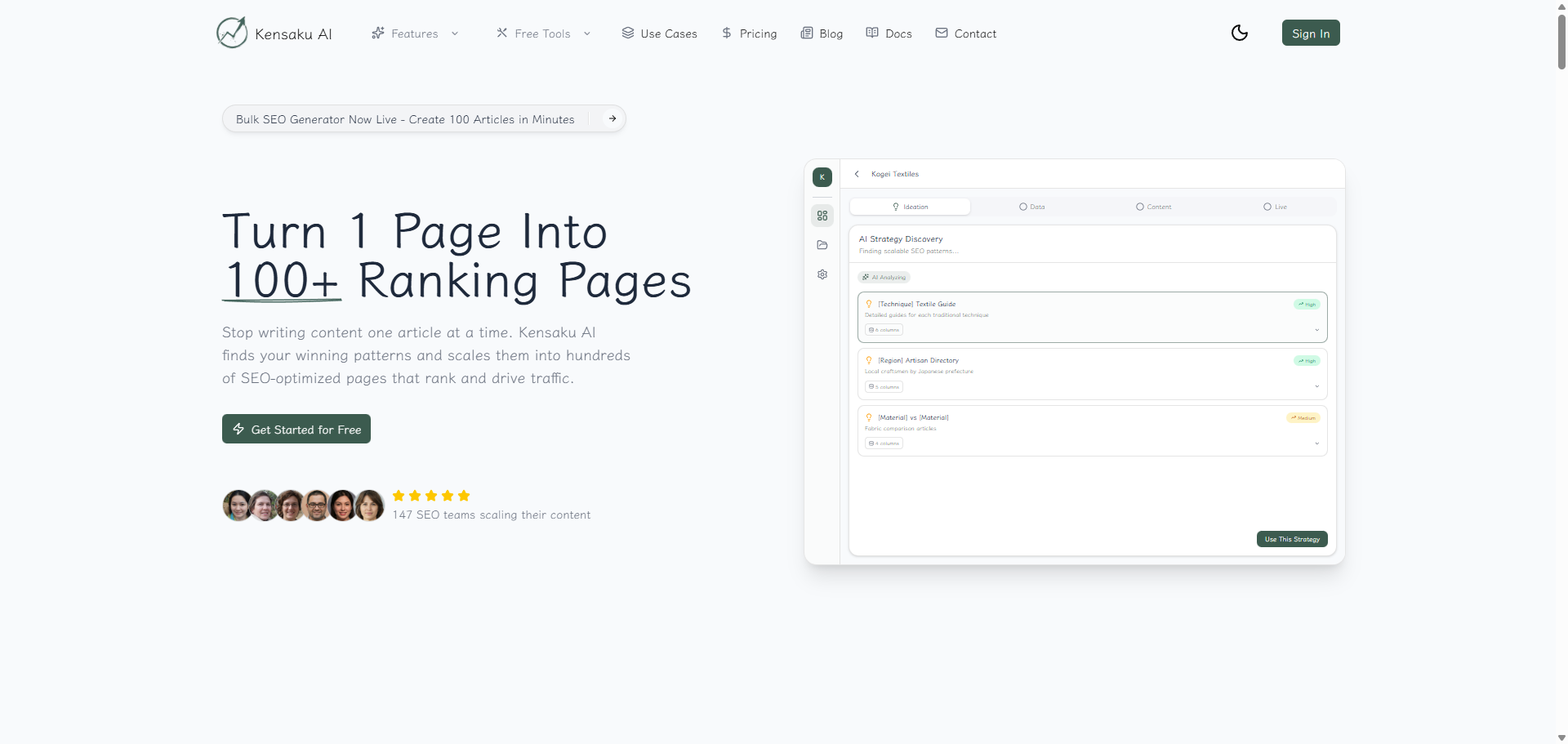
Kensaku AI is a programmatic SEO platform for teams that want to publish content at scale instead of writing pages one by one. You enter your own site or a competitor's URL, and the AI crawls it and proposes four to six repeatable content patterns, each with traffic estimates. You then build a dataset for the pattern you pick and turn it into a batch of SEO-optimized pages.
The workflow centers on structured data. Datasets can be imported from CSV, pasted in, or entered row by row, and AI enrichment fills empty cells with text, images, Google Maps embeds or charts, with optional Google Search grounding. Templates use {{variables}} to produce up to 100 articles per batch, with automatic internal linking. A humanness score checks drafts for typical AI vocabulary and repetitive sentence patterns. Finished pages can go to WordPress, be exported as CSV or JSON, or be served through a REST API.
Who it's for
- SEO teams and strategists
- Agencies running content for clients
- Affiliate and niche site owners
- SaaS marketers building landing pages
- Developers who need SEO content via API
How to use Kensaku AI
- 1
Analyze a website
Enter your site or a competitor's URL. The AI crawls it and suggests 4-6 scalable content patterns with traffic estimates.
- 2
Build the dataset
Import a CSV, paste data or add rows by hand, then use AI enrichment to fill missing cells with text, images, maps or charts.
- 3
Generate pages in bulk
Choose a content type such as a listicle, comparison or how-to, write a template with {{variables}}, and generate up to 100 articles in one batch.
- 4
Publish or export
Push articles to WordPress on a schedule, export them as CSV or JSON, or pull them into any stack through the REST API.
Kensaku AI key features
Website analyzer for programmatic SEO
Crawls a site, detects patterns and recommends page strategies with estimated traffic.
Bulk content generator
Several content types and variable-based templates, up to 100 articles per batch with automatic cross-linking.
AI data enrichment
Fills dataset cells with text, images, maps and charts, with optional Google Search grounding for current information.
WordPress content automation
Publishes directly to WordPress with scheduling, a calendar view for planning and auto-sync through a plugin.
Humanness scoring
Checks drafts for AI-typical vocabulary, sentence variance and naturalness, and rejects content that reads as robotic.
JSON:API access
Public and private endpoints with pagination, filtering and CSV/JSON export for custom integrations.
Kensaku AI use cases
Location pages at scale
Generate city or region pages from a location dataset, enriched with map embeds and images.
Comparison and 'X vs Y' pages
Turn a product list into comparison pages that target long-tail search queries.
Industry landing pages
Create pages for each industry or segment, such as 'CRM for [industry]', from one template.
Content for headless or custom sites
Serve generated, enriched content to any tech stack through the REST API instead of WordPress.
Kensaku AI FAQ
What is Kensaku AI?
Kensaku AI is a programmatic SEO platform. It suggests scalable content patterns for a website, helps build and enrich datasets, and generates SEO-optimized pages in bulk.
Is Kensaku AI free?
There is a free trial, and the site says no credit card is required to start. Ongoing use runs on paid monthly subscription plans. The site also offers a set of free standalone SEO tools.
How do I do programmatic SEO with Kensaku AI?
Analyze your site to get pattern suggestions, build a dataset from CSV or manual input, create a template with {{variables}}, and generate up to 100 articles per batch.
Can the AI content generator publish to WordPress?
Yes. Articles can be pushed to WordPress with scheduling and planned in a calendar view, and a plugin handles auto-sync.
Does Kensaku AI have an API?
Yes. It offers a JSON:API with public and private endpoints, pagination, filtering and CSV/JSON export, so content can be used in any tech stack.
How does this AI SEO tool keep content from sounding robotic?
Its humanness scoring checks for AI-typical vocabulary, sentence variance and natural patterns, and rejects content that reads as robotic. An optional humanization review is also available.
This introduction is based on the public pages of kensakuai.com, read on October 9, 2026.